
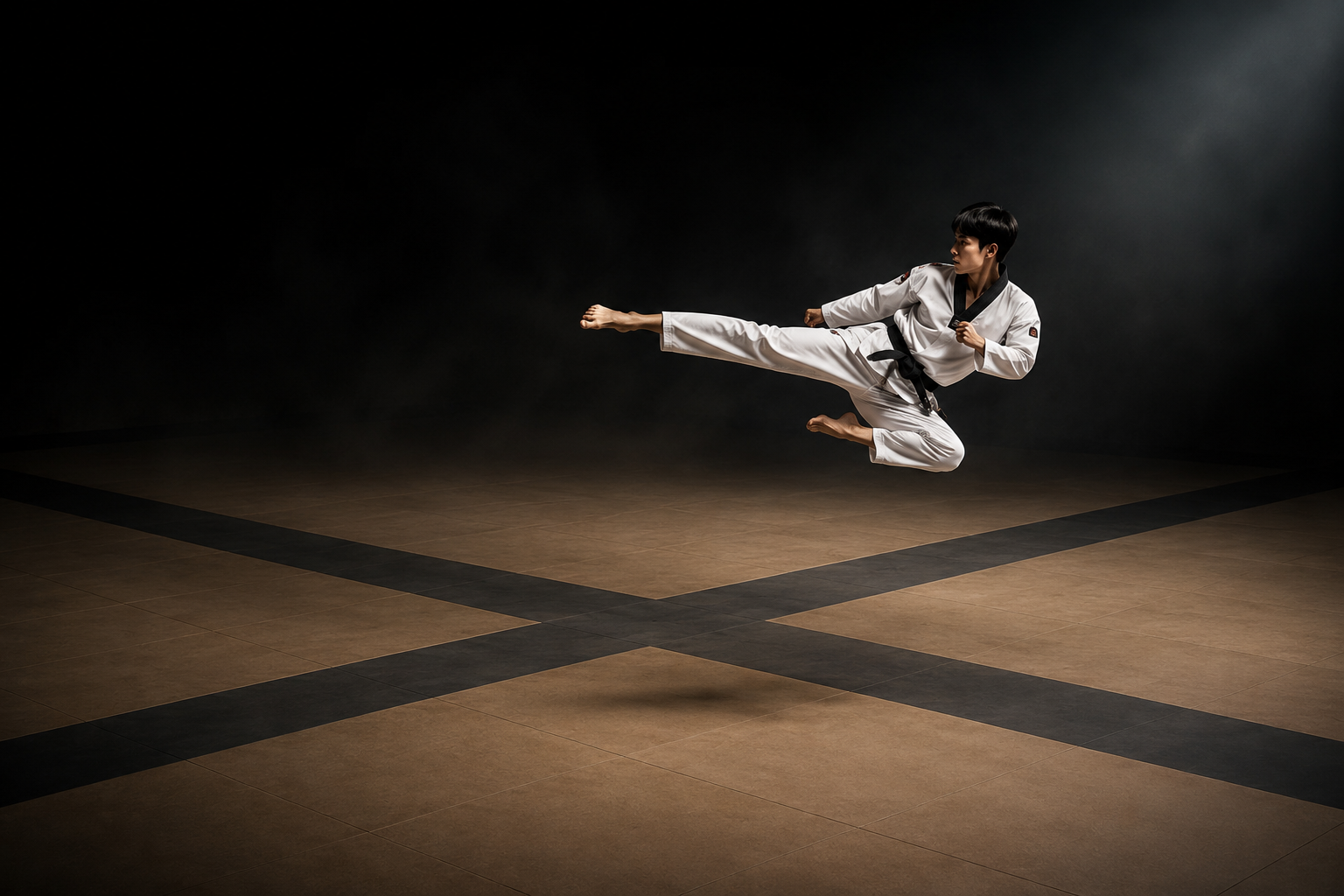
Traditional Taekwondo.
Built for modern athletes.
We don't replace Taekwondo with fitness. We build better athletes around Taekwondo.
Students learn the traditional curriculum — stances, kicking, blocks, poomsae, sparring, etiquette, and rank progression — while age-appropriate strength, plyometrics, mobility, coordination, and conditioning help prepare their bodies for the demands of training.
Traditional fundamentals, kicking mechanics, poomsae, and controlled sparring.
Strength, balance, mobility, coordination, explosiveness, and endurance.
Discipline, confidence, responsibility, composure, and progressive independence.
More than kicking.
Taekwondo develops technique, coordination, discipline, and control. ARC adds structured athletic conditioning to help students build a stronger, more capable body around those skills. Short conditioning blocks are incorporated into training using age-appropriate plyometrics, strength work, movement drills, and cardiovascular exercise.
Plyometrics
Develop the ability to produce force quickly — and control the body when it comes back down.
Supports explosiveness, quicker direction changes, jumping ability, and the power students need as their kicking becomes more advanced.
Strength Training
Develop strength that carries into movement, stability, and technique.
Develops the legs, hips, trunk, and upper body that support stronger stances, better posture, more stable kicking, and overall physical capacity.
Movement & Mobility
Strength becomes more useful when students can move efficiently through different positions and directions.
Helps students change direction, maintain balance, control their body through larger ranges of motion, and move more efficiently during training.
Conditioning
Build the capacity to maintain technique and composure as physical demand increases.
Builds the work capacity needed for longer classes, repeated kicking combinations, sparring rounds, testing, and competition preparation.
Conditioning supports Taekwondo. It doesn't replace it.
Students still spend the majority of training learning and refining Taekwondo. Conditioning is used deliberately throughout the week to strengthen the physical qualities that support better movement and performance on the mat.
Dynamic movement, mobility, coordination, and activation.
Taekwondo technique, kicking, poomsae, and sparring.
Strength, power, agility, or work-capacity training.

The exercise changes with the student.
Younger students may build strength through bodyweight exercises, jumping, crawling, carrying, balance, and movement games. Older and more experienced students can progress to greater resistance, more complex plyometrics, and higher training demands. Technique and control come before added load.
Taekwondo can fit around the sports they already love.
ARC Motion is not designed to make students choose one activity and abandon everything else. Many of the physical qualities built through taekwondo can complement the sports they already play.
Footwork, balance, coordination, mobility, strength, reaction, and conditioning carry across athletic environments — while other sports can bring useful movement experiences back onto the mat.
Taekwondo
The common base: body control, disciplined repetition, bilateral coordination, power, mobility, and the ability to perform technique under pressure.
Soccer
Constant footwork and changes of direction pair naturally with the lower-body demands of taekwondo.
Swimming
A full-body conditioning sport that develops endurance without adding the same impact demands as running and jumping.
Gymnastics
One of the strongest complements for students developing advanced kicking, balance, mobility, and aerial control.
Basketball
Fast transitions, jumping, reaction, and lateral movement reinforce many of the athletic qualities used in sparring.
The goal is broader athletic development — not specialization for its own sake.
A soccer player does not need to stop playing soccer to train taekwondo. A swimmer does not need to become a full-time martial artist. ARC Motion can occupy its own place in the week while adding another type of movement, instruction, and physical challenge.
Find your place on the mat.
Four divisions. One traditional path. Choose a class to see how training changes with age, maturity, and experience.
Their first experience of the dojang should feel like a win.
A 30-minute introduction built for small bodies and short attention spans: balance, coordination, listening, courage — and their first bow.
The cub grows into the tiger on our crest.
Build the traditional foundation.
The full traditional curriculum, taught at youth pace: stances, kicks, blocks, poomsae, and the belt path from white toward black. Placement considers age, maturity, experience, and rank.
Learn the vocabulary of taekwondo before increasing speed, complexity, and pressure.
Train with intent.
Technique, poomsae, controlled sparring, and leadership reps as older students model for younger ones. Classes are timed so ARC academic students can move directly from the classroom to the mat.
More responsibility. More precision. More ownership of how you train.
Start at any age.
The same curriculum and the same rank system at any age. Many adults begin the week their child does — and stay long after. Parents are welcome; beginners are expected.
Black belts begin as white belts. Adults do too.
Middle-school students may fit either Youth or Teens. Placement is the instructor's call based on maturity, experience, and rank.
The Belt Path.
Rank at ARC is earned through progression in technique, poomsae, control, and understanding. Each belt adds new technical expectations while reinforcing the skills developed at the previous level.
Beginning
Students begin with basic dojang expectations, fundamental stances, blocks, balance, and their first kicking mechanics.
Foundation
Fundamentals begin to take root as students strengthen stance, balance, combinations, and consistent repetition.
Control
Students begin combining techniques while learning to generate additional speed and power without sacrificing control.
Growth
The technical vocabulary grows. Students work through longer sequences while introducing more demanding kicking mechanics.
Development
Students continue refining fundamentals while expanding their ability to generate force in multiple directions.
Application
Technique begins moving beyond isolated drills. Students introduce controlled one-on-one sparring while expanding kicking ability.
Stability
Students are expected to demonstrate stronger technical consistency, composure, and control as training demands increase.
Responsibility
Students consolidate advanced color-belt skills while demonstrating greater maturity, control, and technical responsibility.
Candidacy
Students prepare for black-belt testing by refining the complete color-belt curriculum and demonstrating greater independence.
Advancement
Black belt marks a transition from learning the foundation to refining it through greater consistency, leadership, and technical depth.
Students test when they are ready.
Time in class matters, but time alone does not determine rank. Promotion means a student can consistently demonstrate the technical requirements, control, and responsibility expected at the current belt.
Students must remember and perform the required poomsae and technical material without depending on constant instructor prompting.
Kicks, stances, blocks, and combinations must show the balance, accuracy, control, and power appropriate for the student's level.
As rank increases, sparring, combinations, endurance, composure, and independent execution become part of the promotion standard.
You’ve seen the Motion.
Now see the whole ARC.
ARC | MOTION is one half of the model. Explore the academic side of ARC, or learn why we chose to build a program where intellectual development and physical training support one another.
See how we train the other side.
Academic support, reasoning, diagnostics, targeted instruction, and long-term preparation designed to strengthen how students think, learn, and perform.
Why we decided to build both.
Students do not develop in separate academic and physical compartments. Learn why ARC connects reasoning, discipline, movement, confidence, and performance within one larger developmental model.